Introduction
If you search "careers in digital marketing," you'll get a flood of listicles promising six-figure salaries and remote freedom by month three. That's not how it works, and if you've spent any time actually doing the job, you already know that. At Digitory Marketing, we've hired, trained, and worked alongside digital marketers at every stage, from interns figuring out what a keyword even is to managers running six-figure ad budgets. This article is our honest attempt to show you what these careers actually look like: the roles, the pace of growth, the skills that matter, and the mistakes that slow people down.
If you're weighing whether to get into this field, or you're already in it and wondering where it leads, this should give you a clearer, more grounded picture than the usual hype.
What Digital Marketing Careers Actually Look Like Today
Digital marketing isn't one job. It's a cluster of specialties that all feed into the same goal: getting a business in front of the right people online and turning that attention into revenue. Someone doing SEO all day has a very different routine from someone running paid social campaigns, even though both sit under the "digital marketing" umbrella.
Most people who search for digital marketing career growth expect a single, obvious ladder. In practice, it's closer to a web. You might start in social media management, pick up copywriting along the way, move into email marketing, and end up specializing in marketing automation. None of that is wasted movement. It’s how most senior marketers actually get built.
The other reality worth naming up front: this field rewards people who can show results, not just people who hold the right title. A junior marketer who can prove they improved click-through rate or lowered cost per lead will often move faster than someone with a fancier job title but no measurable wins.
/blog/digital-marketing-1/social-media-marketing-services-package-42
What Does a Digital Marketer Actually Do, Day to Day?
On any given day, a digital marketer might be:
- Checking campaign performance in Google Ads or Meta Ads Manager
- Writing or editing copy for an email send or landing page
- Pulling a report to see which keywords are driving traffic
- Scheduling social content and replying to comments
- Sitting in a call with a client or manager to explain what's working and what isn't
It's less glamorous than the highlight reels on LinkedIn suggest. A lot of the job is small, repetitive optimization: testing a subject line, adjusting a bid, rewriting a headline that isn't converting. The people who grow fastest in this field are usually the ones who stay curious about ’why” something worked, not just satisfied that it did.
The Main Digital Marketing Roles and Where They Lead
Here's a practical breakdown of the most common specializations and the kind of path each one tends to open up.
SEO Specialist
Starts with keyword research, on-page optimization, and technical audits. Over time, this can lead into content strategy, technical SEO leadership, or even in-house SEO manager roles at larger companies. The SEO specialist career path tends to reward patience, since results build over months, not days.
Social Media Manager
Begins with content calendars, community management, and platform-specific strategy. Social media manager career growth often moves toward brand strategy, influencer partnerships, or paid social specialization, since organic reach alone rarely satisfies business goals anymore.
Content Marketer / Copywriter
Starts with blog posts, email copy, or ad copy. A strong content marketing career path usually branches into content strategy, editorial leadership, or conversion copywriting, which tends to pay noticeably more once you can prove your words move revenue.
PPC / Paid Media Specialist
Manages ad spend across Google, Meta, or other platforms. This role has a fairly direct growth line: junior specialist, then paid media manager, then head of performance marketing, because budget responsibility scales with experience here more clearly than in most other tracks.
Email Marketing Specialist
Builds sequences, manages segmentation, and tracks deliverability and open rates. Often becomes a stepping stone into marketing automation or lifecycle marketing roles, which are in growing demand as more companies invest in retention over pure acquisition.
None of these tracks are locked. Plenty of people move sideways between two or three of them before settling into a specialty, and that lateral movement is normal, not a red flag on a resume.
Is Digital Marketing a Good Career in 2026?
Short answer: yes, with a caveat. Digital marketing is still a good career in 2026 because businesses of every size, from local shops to global brands, need people who can reach customers online. That demand hasn't slowed down.
The caveat is that the bar for entry-level work has gone up. AI tools now handle a lot of the repetitive tasks that used to be entry points into the field, like basic copywriting drafts or simple data pulls. That means new marketers need to move faster into strategy and analysis than they did five years ago. The future of digital marketing careers belongs to people who can use AI tools to work faster, then apply human judgment to interpret results and make decisions, not to people who avoid the tools altogether.
How to Become a Digital Marketer (Even Without a Degree)
This is one of the more genuinely encouraging truths about the field: how to become a digital marketer has very little to do with your degree. We've worked with marketers who studied economics, biology, and fine arts. What actually gets people hired is proof of work.
A practical path looks like this:
- Pick one or two channels to learn first. Trying to learn SEO, paid ads, email, and social all at once usually means learning none of them well.
- Get a foundational certification. Google's Skillshop, HubSpot Academy, and Meta Blueprint are free or low-cost and widely recognized.
- Build something real. Run a small campaign for a friend's business, start a blog and track your own SEO results, or manage a social account and document your growth.
4. Package it into a portfolio. Employers want to see decisions and outcomes, not just certificates.
This is exactly the kind of digital marketing career without a degree that we see succeed most often: someone who built a small, honest portfolio beats someone with a marketing degree and nothing to show for it.
Skills and Certifications That Actually Move the Needle
Not all digital marketing skills needed for this field carry equal weight. Based on what we are looking for when hiring, these matter most:
Analytics literacy. Being comfortable in Google Analytics or a similar platform, and knowing how to read a report, not just pull one.
Basic copywriting. Even specialists in paid ads or SEO need to write clear, persuasive copy.
Platform-specific know-how. Google Ads, Meta Ads, and SEMrush are still the tools most agencies and companies expect familiarity with.
Working knowledge of AI tools. Using AI to speed up research, drafting, or reporting is now a baseline expectation, not a bonus skill.
Does digital marketing certifications worth it? the HubSpot Inbound Marketing and Email Marketing certifications, Google Ads certification, and Google Analytics certification are the ones we see referenced most often in hiring conversations. They won't replace real experience, but they signal that you understand the fundamentals, and they're a reasonable way to fill a gap while you build your portfolio.
How Fast Can You Actually Grow in Digital Marketing?
This is the question behind your original title, so let's answer it directly. Digital marketing career growth is faster than in a lot of traditional industries, but it's not automatic. Growth tends to follow a pattern:
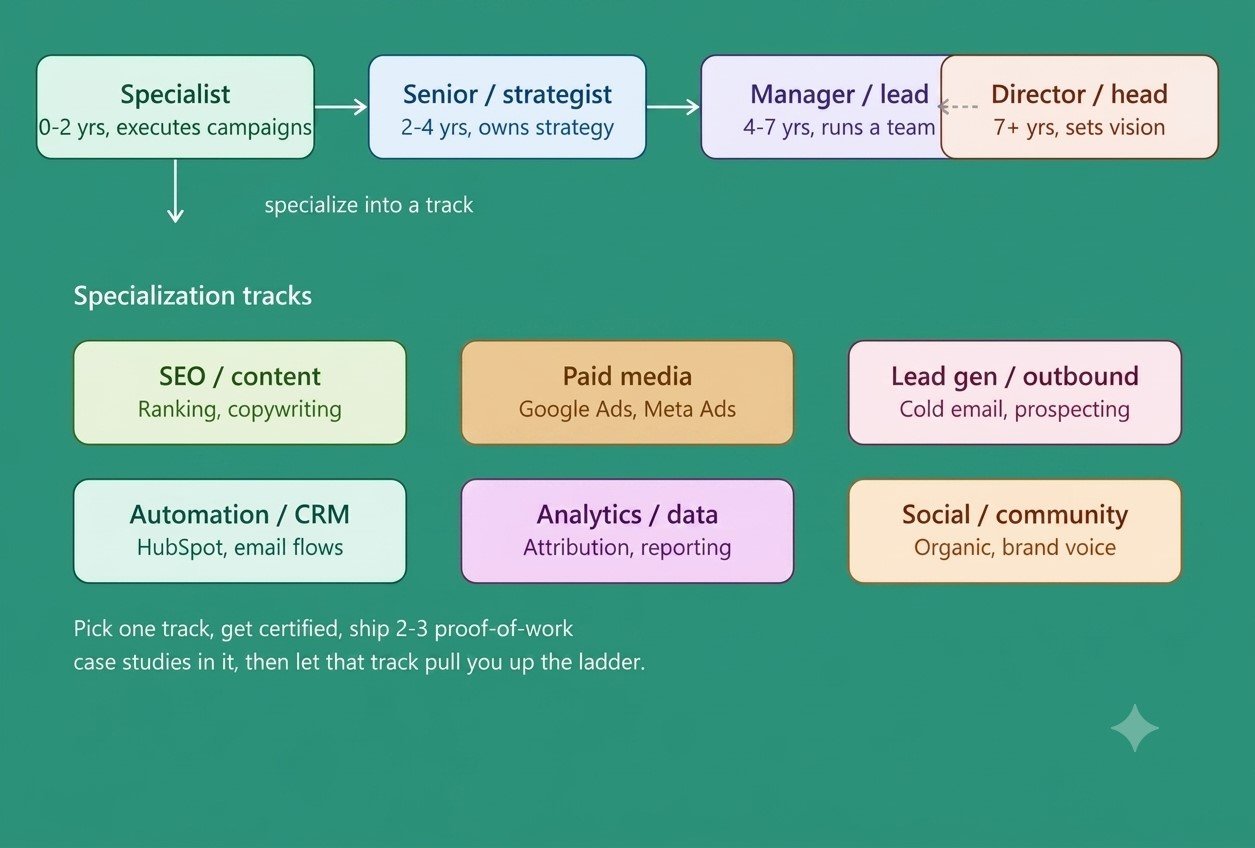
Year 1: Learning the tools and one or two channels. Titles like marketing assistant or junior specialist.
Year 2 to 3: Owning a channel or a small set of campaigns independently. Titles like specialist or coordinator.
Year 3 to 5: Managing strategy across channels, possibly managing a small team. Titles like marketing manager or channel lead.
Year 5+: Directing overall marketing strategy or specializing deeply enough to command senior consultant or freelance rates.
The honest version of how to grow in digital marketing is this: growth speeds up the moment you can tie your work to a number a business cares about, like leads, revenue, or cost savings. People who stay focused only on tasks, without connecting them to outcomes, tend to plateau at the coordinator or specialist level regardless of how many years they've put in.
Freelance, Agency, or In-House: Which Path Grows You Faster?
There's no single right answer here, but each path shapes your growth differently.
Agency life exposes you to more industries and problems in a shorter time. You'll likely learn faster, but the pace can be intense, and you're often juggling several clients at once.
In-house roles let you go deep on one brand. You'll understand a business's customers and data better than an agency generalist would, but your exposure to different strategies is narrower.
Freelancing gives you control over your workload and client mix, and it can be lucrative once you have a track record. But it demands business skills, like pricing, contracts, and client management that most marketing courses don't teach.
In our experience, agency work is often the fastest way to build a broad skill set early on, which is part of why agencies like ours tend to be a strong starting point for people serious about long-term growth in this field.
Salary Growth and Highest-Paying Digital Marketing Roles
Digital marketing salary progression varies by region, specialization, and whether you're freelance or salaried, so we won't invent specific numbers here. What we can say from experience is the general pattern: paid media and marketing automation specialists tend to command higher salaries than generalist roles, because their work ties more directly and visibly to revenue. Leadership roles, like head of growth or VP of marketing, pay the most but usually require five or more years of demonstrated results across multiple channels.
If salary is a major driver for you, specializing in paid media, SEO strategy, or marketing automation, rather than staying a generalist, tends to open the highest-paying digital marketing jobs faster.
Practical Tips to Advance Your Digital Marketing Career
A few digital marketing career advancement tips that consistently work, based on what we've seen with our own team and clients:
Document your results, not just your tasks. "Increased email open rate by X" is more valuable on a resume than "managed email campaigns."
Learn the number behind the campaign. Understand cost per lead, conversion rate, and return on ad spend, even if it's not your direct responsibility.
Don't skip the boring channels. Email marketing and SEO don't have the buzz of paid social, but they're often where the most durable career growth happens.
Ask for feedback on strategy, not just execution. It signals you're ready to think beyond the task list.
Common Mistakes That Slow Career Growth
We see the same handful of mistakes repeatedly:
- Trying to learn every channel at once instead of going deep on one or two first
- Chasing certifications instead of building a portfolio of real work
- Avoiding data and reporting because it feels less creative
- Staying in a generalist role too long without picking a specialty to build authority in
None of these are fatal. They're just common friction points that are easy to fix once you notice them.
Key Takeaways
- Digital marketing careers rarely follow a single, linear path. Lateral movement between specialties is normal.
- Roles like SEO, social media, content, PPC, and email marketing each have their own growth track, but they often overlap.
- A degree isn't required. A portfolio of real, documented work matters more to most employers.
- Growth speeds up once you can tie your work to measurable business outcomes.
- Agency, in-house, and freelance paths each shape your skill set differently. There's no universally "best" choice.
- AI tools are changing entry-level work, so building strategic and analytical skills early matters more than ever.
FAQ
- Is digital marketing a good career in 2026?
Yes. Demand for digital marketers remains strong across nearly every industry, though entry-level candidates now need to move into strategic and analytical work faster than in previous years.
- Do I need a degree to become a digital marketer?
No. Many successful digital marketers come from unrelated fields. A portfolio of real campaigns or projects usually matters more to employers than a specific degree.
- Which digital marketing role pays the most?
Paid media, marketing automation, and senior leadership roles like head of growth tend to pay the most, since their work connects most directly to revenue.
- How long does it take to grow from entry-level to management in digital marketing?
Most people move into management-level roles within three to five years, though this depends heavily on how quickly they can show measurable results.
- Is it better to start my career at an agency or in-house?
Agencies typically offer faster, broader learning across industries and channels. In-house roles offer deeper focus on one brand. Neither is objectively better; it depends on your learning style and goals.
- What skills should I prioritize first in digital marketing?
Start with analytics literacy and one core channel, like SEO or social media, before branching out. Employers value depth in one area over shallow familiarity with everything.