Introduction
Most FAQ pages get written as an afterthought. Someone lists a handful of questions customer support hears often, writes short answers, and moves on. That approach might check a box, but it rarely builds an FAQ page that ranks and converts. A well-built FAQ page does real work: it answers the questions that stall a buying decision, it helps search engines and AI assistants understand your business, and it can now directly shape how tools like ChatGPT and Perplexity summarize your brand to someone who never even visits your site.
This matters more in 2026 than it used to. Search behavior has shifted toward zero-click answers, where people get what they need from an AI summary instead of clicking through to a website. An FAQ page that ranks and converts is one of the most efficient ways to stay visible in that shift, because it already pairs a clear question with a direct answer, which is exactly the format AI systems look for when deciding what to cite.
This article walks through how to choose the right questions, structure answers that actually get cited, use FAQ schema correctly now that its role has changed, and turn what is often treated as an afterthought page into one that earns both search visibility and real conversions. what faq seo mistakes are costing-you
What Is an FAQ Page, and Why Does It Still Matter?
An FAQ page is a dedicated section that answers common questions a visitor has before they buy, sign up, or reach out. Done well, it reduces support tickets, builds trust by addressing objections upfront, and gives search engines and AI tools a clean, structured source to pull from.
Some businesses assume FAQ pages lost relevance once AI search became common. The opposite is closer to the truth. Because an FAQ page already presents information as a question paired with a direct answer, it is one of the easiest page types for an AI system to extract, understand, and cite. A well-written FAQ page that ranks and converts is now doing double duty: helping human visitors and feeding AI answer engines at the same time.
There is also a business case beyond search visibility. A well-maintained FAQ page reduces repeat questions to sales and support teams, since visitors get the same accurate answer instantly instead of waiting on a reply. That alone can save meaningful time for small teams juggling multiple roles.
How Do You Choose the Right Questions?
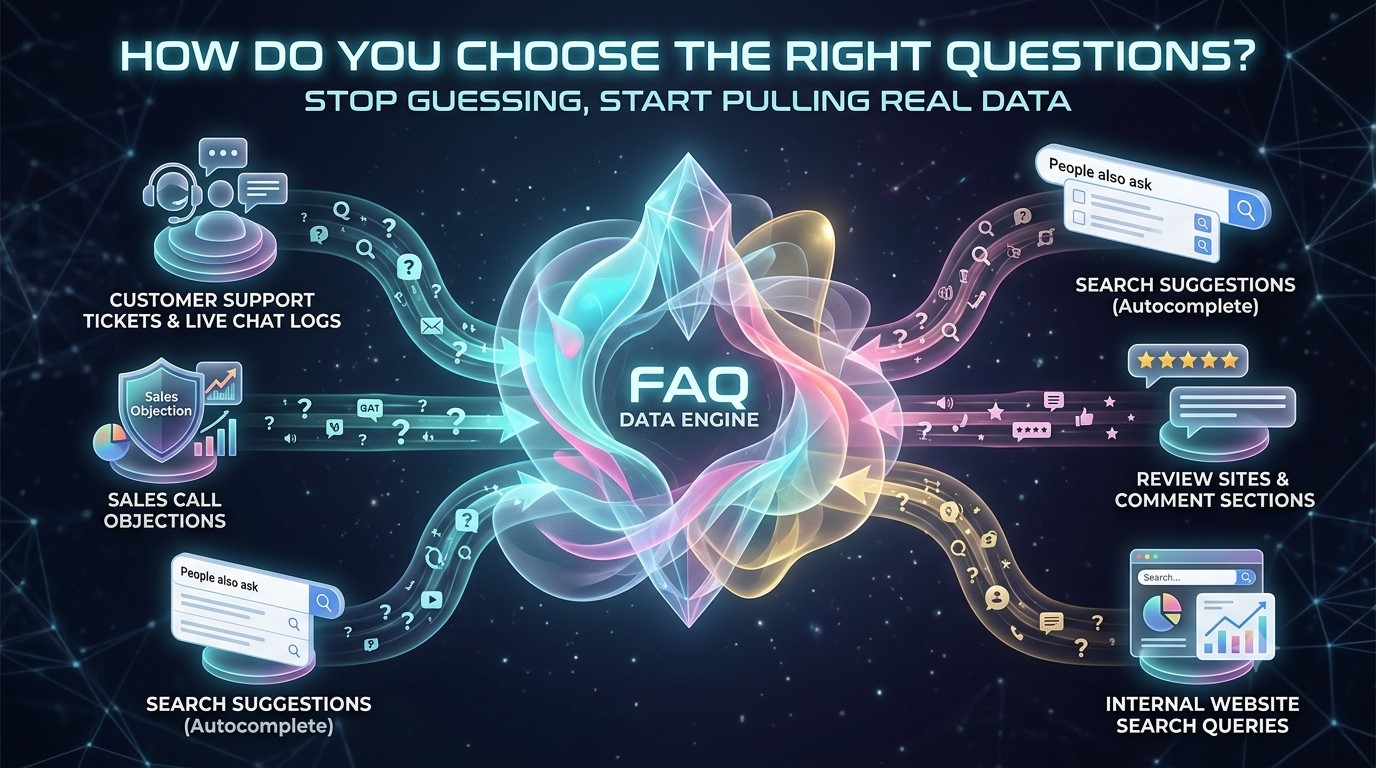
The biggest mistake in FAQ writing is guessing. Instead, pull real questions from sources that reflect what people actually ask:
- Customer support tickets and live chat logs
- Sales call objections and follow-up questions
- Search suggestions like autocomplete and “People also ask” boxes
- Review sites and comment sections, where people voice hesitations
- Internal search queries on your own website, if you track them
Good FAQ questions are specific, not generic. "How much does this cost?" performs better than "Tell me about pricing," because it mirrors how someone actually types or speaks a question to a search engine or an AI assistant.
Avoid duplicating a question you already answer in an H2 elsewhere on the page. If your main content already has a heading answering, "How does this work?", use the FAQ for a related but distinct question instead, such as "How long does setup take?" This keeps the FAQ page useful rather than repetitive, and it gives AI systems more distinct, citable content instead of the same answer twice. faq schema markup rankings
How Do You Write Answers That Actually Rank?
Short, direct answers rank and get cited more consistently than long, vague ones. A strong structure looks like this:
- Answer the question in the first sentence. Do not build up to it.
- Add supporting detail in the next one to three sentences. Context, numbers, or a brief example.
- Stop. An FAQ answer is not the place for a full explainer. Link to a longer article if the topic deserves more depth.
This structure works for human readers who are scanning for a quick answer, and it works just as well for AI systems that extract short, self-contained chunks of text to generate a summary or a direct answer. Writing this way is one of the most reliable ways to build an FAQ page that ranks and converts, because it satisfies both audiences with the same content instead of writing two different versions.
What Is FAQ Schema Markup, and Is It Still Worth Using in 2026?
FAQ schema, technically called FAQPage structured data, is code added to a page that explicitly labels which text is a question and which text is its answer. For years, this schema could trigger an expandable FAQ box directly in Google's search results.
That changed in 2026. Google stopped showing the FAQ rich result in search as of May 2026, and reporting tools tied to it, including parts of Search Console, are being phased out through the following months. Some site owners have taken this as a signal to strip FAQ schema out entirely. That is a mistake.
FAQPage schema is still a valid, recognized structured data type, and its value has simply shifted. Instead of earning a visual rich snippet in Google, it now helps AI systems parse your questions and answers with more confidence, since the markup removes any ambiguity about what a question is and what is its answer. If you want your content included in an AI Overview, a ChatGPT response, or a Perplexity summary, schema still improves the odds that the system extracts your content cleanly rather than misreading it.
One rule has not changed: only markup FAQ content that is visible on the page and accurately reflects what is written. Do not use schema to imply promotional claims that are not written out for a human to read. Search engines and AI systems increasingly penalize markup that does not match visible content.
It also helps to think of FAQ schema as infrastructure rather than decoration. It does not create rankings on its own, and it will not force an AI system to cite your page. What it does is remove ambiguity, so that when your content is already strong, the system reading it has an easier time confirming exactly what question is being answered and by whom.
How Do You Turn an FAQ Page Into a Conversion Tool?
Ranking is only half the job. An FAQ page that ranks and converts also needs to move a visitor closer to a decision, not just inform them. A few ways to do that:
- Address pricing, timelines, and process questions directly instead of vaguely, since these are usually the real blockers before someone converts
- Include a light call to action after high-intent answers, such as a link to book a call or start a free trial
- Group questions by stage, separating “just researching” questions from “ready to buy” questions, so each visitor finds what's relevant to them faster
- Keep answers honest. Vague or overly sales-y answers erode the trust an FAQ page is supposed to build.
Common Mistakes That Hurt FAQ Pages
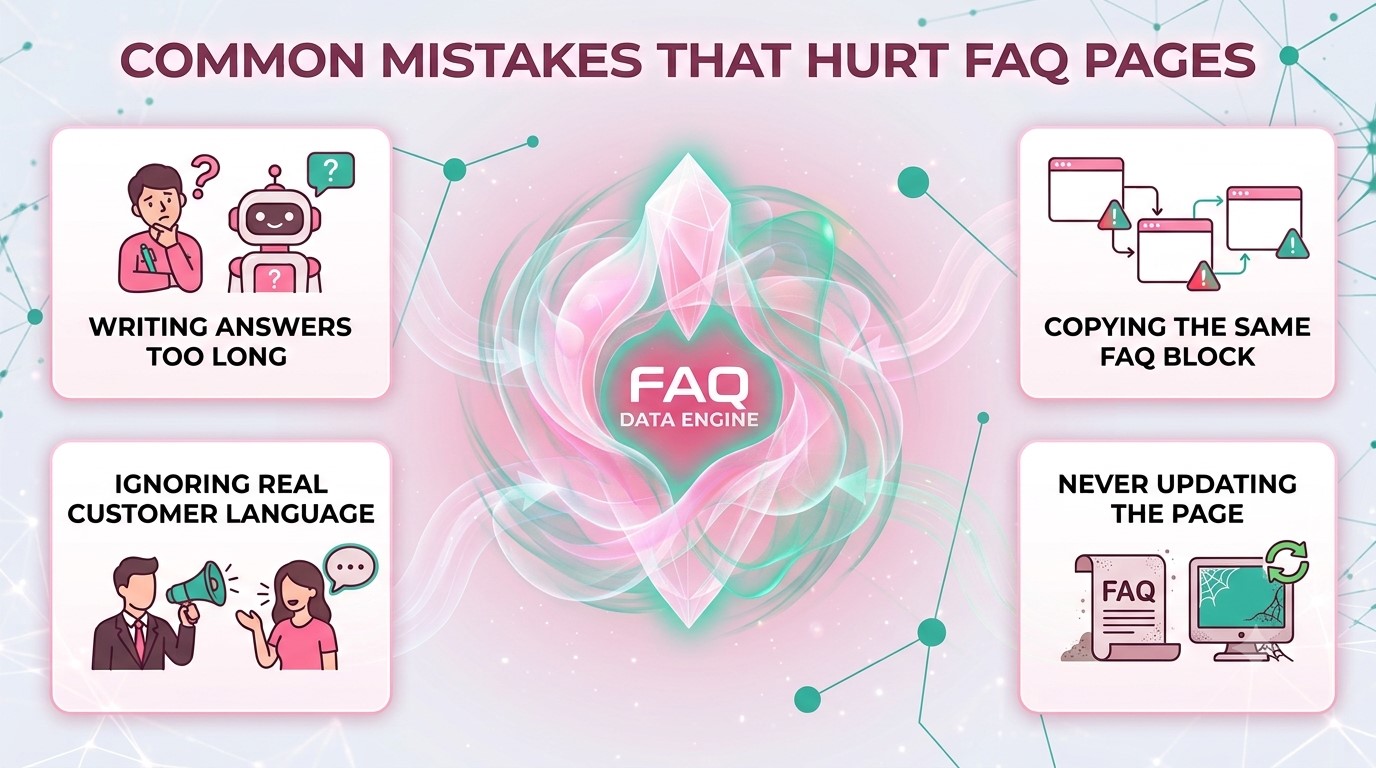
- Writing answers too long. A paragraph that rambles before answering the question loses both readers and AI extraction accuracy.
- Copying the same FAQ block across every page. This creates duplicate content and gives search engines and AI systems nothing distinct to cite.
- Ignoring real customer language. Formal, brand-voice phrasing rarely matches how people actually search or ask questions out loud.
- Treating FAQ schema as decorative. Markup that does not match the visible answer can hurt trust signals rather than help them.
- Never updating the page. Questions shift as products, pricing, and policies change. A stale FAQ page can actively mislead visitors and AI systems alike.
Best Practices for an FAQ Page That Ranks and Converts
- Base every question on real user language, not internal jargon
- Answer first, explain second, and keep each answer self-contained
- Use FAQPage schema correctly, matching markup to visible content exactly
- Update the page regularly as products, pricing, or policies change
- Link out to longer content for topics that need more depth than an FAQ answer allows
- Track which FAQ questions get the most engagement or search traffic and expand on those first. what is faq seo
Where FAQ Content Is Heading
FAQ pages are becoming less about earning a visual badge in search results and more about being a trusted, citable source for AI systems. As more searches end without a click, and as more buyers get their first answer from an AI assistant instead of a website, the businesses that write clear, well-structured FAQ content will be the ones AI tools quote, recommend, and point people back to. Treating an FAQ page as a core piece of content strategy, not an afterthought, is quickly becoming a competitive advantage rather than a nice-to-have.
Expect this trend to accelerate rather than level off. As AI assistants handle more first-touch research for buyers, the businesses whose content is easiest to extract cleanly will keep winning visibility, regardless of how much traditional traffic their website receives directly. An FAQ page that ranks and converts is no longer just a support tool. It is becoming one of the more reliable ways a small business gets represented accurately inside a conversation it never actually sees.
Summary
Writing an FAQ page that ranks and converts comes down to a few consistent habits: research real questions instead of guessing, answer them directly before adding detail, use schema markup correctly even though it no longer produces a visual rich result, and keep the page updated as your business changes. The reward is a page that does more than answer questions. It builds trust, moves visitors toward a decision, and gives AI systems like ChatGPT, Perplexity, Gemini, Copilot, and Claude a clean, citable source to pull your business into their answers.
In a search landscape where more answers happen before a click ever occurs, a strong FAQ page that ranks and converts is one of the most direct ways to stay visible, credible, and chosen.
FAQ Section
How do you write an FAQ page that ranks and converts?
Start with real questions pulled from support tickets, sales calls, and search behavior, then answer each one directly in the first sentence before adding brief supporting detail. Pairing clear structure with accurate FAQ schema markup helps both search engines and AI systems understand and cite the content.
What makes a good FAQ page?
A good FAQ page answers specific, real questions rather than generic ones, keeps each answer short and self-contained, and avoids duplicating content already covered elsewhere on the page.
How long should FAQ answers be?
Most effective FAQ answers run one to four sentences. Answer the question immediately, add a bit of context or detail and then stop. Link out to a longer article if the topic needs more depth.
Is FAQ schema still worth using in 2026?
Yes. Google removed the visual FAQ rich result from search in May 2026, but FAQPage schema is still valid structured data. It now plays a bigger role in helping AI systems like ChatGPT and Perplexity accurately parse and cite your Q&A content.
Should every page have an FAQ section?
Not necessarily. FAQ sections work best on pages where real buyer questions and objections exist, such as pricing, product, or service pages. Adding a generic FAQ to every page can create duplicate content instead of useful, distinct answers.
How do you optimize an FAQ page for AI search?
Write direct, self-contained answers using natural, conversational language that matches how people actually ask questions. Use accurate FAQPage schema and avoid duplicating the same FAQ content across multiple pages.
Key Takeaways
- An FAQ page that ranks and converts starts with real customer language, not internal jargon or guesswork.
- Answer the question in the first sentence, then add brief supporting detail. Do not bury the answer.
- FAQ rich results disappeared from Google Search in May 2026, but FAQPage schema is still valid and increasingly useful for AI search citation.
- Only markup FAQ content with schema if it is visible and accurate. Mismatched markup can hurt trust signals.
- Group FAQ content by buyer intent and add light calls to action to turn informational content into a conversion tool.
- Update FAQ pages regularly. Stale answers can mislead both visitors and AI systems.
- As more searches end without a click, well-structured FAQ content becomes a direct path to AI citation and brand visibility.
Contact us at https://www.digitorymarketing.com for your digital marketing services.