Introduction
If you've ever wondered how to use FAQ pages for SEO, you're asking one of the most practical questions in modern search marketing. FAQ sections for SEO have quietly become one of the highest-leverage, lowest-effort tools available to businesses that want to rank for more keywords without writing an entirely new article for every search query.
For US-based B2B and B2C companies running lead generation campaigns, this matters more than it might first appear. A single well-built FAQ section can capture dozens of long-tail searches, answer objections before a prospect ever picks up the phone and even show up directly inside Google's AI Overviews or a ChatGPT-generated answer. This article breaks down exactly how FAQ sections work, why they matter for both traditional SEO and AEO (Answer Engine Optimization), and how to build one that actually moves the needle for your rankings and your lead flow.
What Is FAQ Schema, and Why Does It Matter for SEO?
Before diving into strategy, it helps to understand the technical foundation. What is FAQ schema? It's a form of structured data a snippet of code added to your webpage that tells search engines exactly which parts of your content are questions and which are answers.
When implemented correctly using JSON-LD FAQ schema, this structured data can trigger what's known as a "rich result" in Google an expandable FAQ dropdown that appears directly in the search listing, often pushing your result to take up more visual space on the page than a standard blue link.
Here's why that matters:
- It increases your real estate on the search results page without requiring a higher-ranking position
- It often improves click-through rate, since users can preview the answer before clicking
- It positions your content to be pulled directly into Google rich results FAQ features and AI-generated answers
In short, FAQ schema isn't just a formatting choice it's a direct signal to search engines about the structure and intent of your content, and that signal carries real ranking weight.
https://digitorymarketing.com/blog/digital-marketing-1/content-marketing-ideas-for-beginners
How Do FAQ Pages Help SEO?
So, practically speaking, how do FAQ pages help SEO? The answer comes down to three mechanisms:
1. They Target Long-Tail Keywords Naturally
Most businesses build their core content around short, high competition keywords the kind that are expensive to rank for and slow to move. FAQ content for long-tail keywords solves this by allowing you to naturally include dozens of specific, conversational search phrases that real customers type into Google, without forcing them awkwardly into your main article body.
For example, a logistics company's core page might target “freight forwarding services,” while its FAQ section can capture long-tail variations like "how long does freight forwarding take" or ‘what's the difference between freight forwarding and drop shipping" searches that are lower competition but often closer to buyer intent.
2. They Match Conversational and Voice Search Patterns
Search behavior has shifted heavily toward natural, conversational phrasing partly driven by voice assistants and partly by AI chat interfaces. Can FAQ sections help voice search rankings? Yes, because FAQ content is already structured as a direct question-and-answer pair, which is precisely the format voice assistants and AI models pull from when generating spoken or written answers.
3. They Improve Dwell Time and Reduce Bounce Rate
When users find quick, clear answers to their follow-up questions on the same page, they're less likely to bounce back to Google and search elsewhere. This keeps engagement metrics healthy, which indirectly supports better rankings over time.
FAQ Sections vs. Blog Content: What's the Difference?
A common point of confusion is FAQ vs blog content for SEO are they solving the same problem, or serving different purposes?
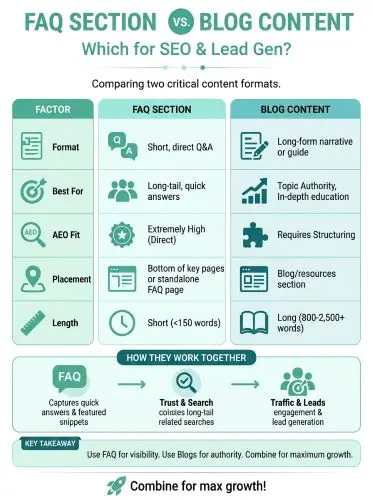
The two aren't competitors they're complementary. A strong content strategy uses blog articles to build authority and rank for broader topics, while using FAQ sections to mop up the long-tail, high-intent searches that a blog post alone can't efficiently capture. /blog/digital-marketing-1/6-reasons-why-digital-marketing-is-crucial-for-small-business-owners-1
How Many FAQs Should a Page Have?
This is one of the most frequently asked implementation questions, and understandably so too few FAQs waste the opportunity, while too many can overwhelm the page and dilute focus.
As a general guideline:
Product or service pages: 4-8 FAQs, focused tightly on objections and buying questions
- Standalone FAQ pages: 15-30 + FAQs, organized into categories for easier navigation
- Blog articles: 3-6 FAQs at the end, directly tied to the article's core topic
The right number ultimately depends on genuine search demand not padding for padding's sake. Every FAQ should map to a real question your audience is actually asking, ideally validated through keyword research, customer support logs, or sales call transcripts.
Where to Place FAQ Sections on a Webpage
Where to place FAQ section on a webpage is a smaller detail with a real impact on both user experience and SEO performance. Best practice generally recommends:
- After the main content, before the footer: - so users who scroll through your primary content naturally land on the FAQ next
- Near pricing or checkout sections: - for e-commerce or service pages, placing FAQs close to the point of decision helps overcome last-minute objections
- As a dedicated FAQ page: - for broader, brand-level questions that don't fit neatly into a single product or service page
Avoid burying your FAQ section deep in a hard-to-find location and avoid hiding all content behind accordion clicks with no visible preview text search engines and users both benefit from at least partial visibility of the answer content.
How to Write FAQ Questions for SEO
Knowing how to write FAQ questions for SEO is where strategy meets execution. Follow this process:
- Start with real questions. Pull directly from Google's "People Also Ask" boxes, customer emails, sales call objections, and support tickets.
- Match the exact phrasing customers use. Avoid overly formal or marketing-heavy language write questions the way a real prospect would type them into Google.
- Answer directly in the first sentence. This is critical for FAQ optimization for featured snippets search engines and AI models favor content that answers the question immediately, then elaborates.
- Keep answers concise but complete. Aim for 40–100 words per answer; enough to fully address the question without turning into a mini-essay.
- Include your target keyword naturally. Don't force it, but make sure the phrasing aligns with how people actually search.
FAQ Sections vs. People Also Ask: What's the Connection?
Google's "People Also Ask" (PAA) boxes are essentially a live feed of real search demand, and there's a direct relationship between FAQ sections vs People Also Ask: the questions that show up in PAA boxes are often the exact questions worth turning into FAQ content on your own site.
By monitoring PAA results for your core topics and building FAQ sections around those same questions, you're essentially reverse-engineering Google's own signal of what people want answered — a far more reliable method than guessing.
Does FAQ Schema Actually Improve Rankings?
This is worth addressing directly, since it's one of the more debated questions in SEO circles. FAQ schema itself does not directly boost your position in standard organic rankings. However, it meaningfully improves:
- Visibility through rich results and expanded search listings
- Click-through rate, which is a strong secondary ranking signal over time
- Eligibility for AI-generated answers, since structured Q&A content is easier for models to extract and cite
In practice, this means FAQ schema functions less like a ranking lever and more like a visibility and traffic multiplier — which, for lead generation purposes, is often just as valuable.
Building an FAQ Content Strategy for Lead Generation
For companies focused on FAQ content strategy for lead generation, the real opportunity lies in treating FAQ sections as a sales enablement tool, not just an SEO checkbox. Each FAQ answer is an opportunity to:
- Pre-handle objections before a prospect ever reaches out
- Reinforce trust signals (pricing transparency, process clarity, guarantees)
- Capture long-tail traffic from prospects who are further along in their buying journey
This is especially valuable for B2B companies with longer sales cycles, where a well-answered technical or pricing question in an FAQ section can be the deciding factor in whether a prospect reaches out at all.
Best Practices for SEO FAQ Sections
To summarize the tactical side, here are the best practices for SEO FAQ sections worth following:
- Base every question on real, validated search demand
- Implement FAQ Page schema markup correctly using JSON-LD
- Keep answers direct, concise, and front-loaded with the answer
- Update FAQ content regularly as new questions emerge from sales and support teams
- Avoid duplicating FAQ content across multiple pages, which can create keyword cannibalization
- Monitor performance through Google Search Console to track which FAQ-driven queries are gaining impressions and clicks
Summary
FAQ sections for SEO represent one of the most efficient ways for a business to rank for more keywords without producing an overwhelming volume of new content. By understanding how to use FAQ pages for SEO, implementing proper FAQ schema, and writing questions based on real search demand rather than guesswork, companies can capture long-tail traffic, improve visibility through rich results, and position their content for the growing wave of AI-driven, AEO-optimized search.
For any US-based B2B or B2C company serious about lead generation, FAQ sections shouldn't be treated as an afterthought tacked onto the bottom of a page. Done well, they function as a quiet, compounding engine answering real questions, building trust, and turning search visibility into qualified leads over time.