There's no universally correct answer to whether marketing should live in-house or get handed to an agency, despite how confidently either side tends to argue its case. The right choice depends on budget, the specific skills needed, how much day-to-day control matters, and how quickly a business needs to scale. Choosing between an in-house team or agency comes down to weighing tradeoffs specific to your situation, not picking whichever option sounds more impressive.
This guide breaks down what each option actually offers, so the decision is based on real tradeoffs rather than general assumptions.

What "In-House" Actually Means
An in-house marketing team consists of employees working directly for the business, embedded in its culture and priorities full-time. This typically means one or more dedicated roles, a content writer, a social media manager, an SEO specialist, depending on the scope of work needed, all reporting directly within the company rather than through an external contract.
What "Agency" Actually Means
An agency is an external company hired to handle some or all marketing functions, typically working across multiple clients simultaneously. Agencies range from small specialized shops focused on one service, like SEO content writing, to full-service agencies covering social media, content, paid ads, and strategy together.
Comparing Cost
In-house hires typically involve salary, benefits, and the ongoing overhead of employment, which adds up even for a single role, and multiplies quickly if multiple specialized skills are needed. Agencies generally cost less than an equivalent in-house team for the same scope of work, since the cost is spread across multiple clients, though a comprehensive agency retainer can still be substantial. When comparing an in-house team or agency purely on cost, it's important to factor in the full scope of work, not just the headline number, since a cheap hire missing key skills or an underscoped agency retainer can both end up costing more in the long run.
Comparing Expertise and Range of Skills
A single in-house hire typically brings expertise in one or two specific areas, which can be a limitation if the business needs a broader range of skills like SEO, paid ads, and social media simultaneously. An agency usually has a team with varied specializations available, meaning a broader skill set is accessible without hiring several full-time employees. The tradeoff is that an in-house hire develops much deeper, more specific knowledge of the business itself over time than an agency team splitting attention across multiple clients typically can.

Comparing Control and Communication
An in-house team is available for immediate, informal communication throughout the day, and tends to align more closely with company culture and priorities simply through daily proximity. Agencies typically operate on a more structured communication cadence (scheduled calls, defined reporting), which works well for many businesses but can feel slower for decisions that need to happen quickly. Choosing between an in-house team or agency here often comes down to how much day-to-day involvement and speed actually matters for a specific business's workflow.
Comparing Scalability
Agencies scale up or down more easily than an in-house team, since adjusting a contract's scope is generally simpler and faster than hiring or laying off employees. This makes agencies a strong fit for businesses with fluctuating marketing needs, a seasonal push, a product launch, or uncertain future budget. In-house teams, once built, tend to be more stable but harder to scale quickly in either direction.
When an In-House Team Tends to Make More Sense
An in-house team often fits better for businesses with a consistent, high enough volume of marketing work to justify a full-time role, a need for deep, ongoing familiarity with the product or industry, or a preference for tight day-to-day control over brand voice and messaging. Larger businesses with more complex marketing needs often land here once volume justifies the investment.
When an Agency Tends to Make More Sense
An agency generally fits better for smaller businesses without the budget or volume to justify a full-time hire, businesses needing a broad range of specialized skills without hiring multiple people, or situations requiring quick scalability, like a seasonal campaign or a new market launch. Our guide on what questions to ask before buying social media marketing services covers how to vet a provider once this route makes sense.
The Hybrid Approach Worth Considering
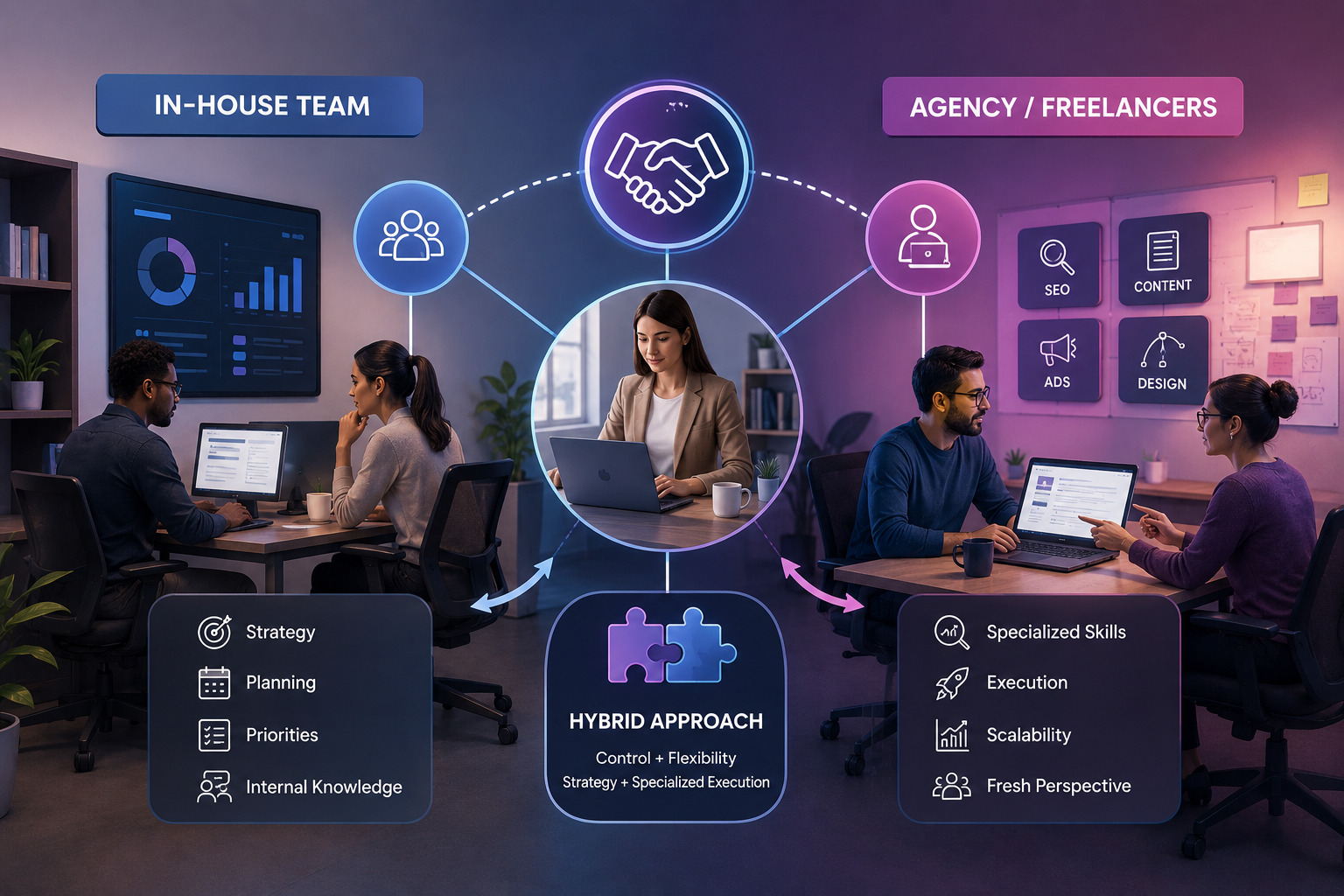
Plenty of businesses land somewhere in between: an in-house marketing lead or coordinator who manages strategy and day-to-day priorities, paired with an agency or freelancers handling specialized execution like SEO content or paid ads. This hybrid model captures some of the control and institutional knowledge of an in-house presence while still accessing broader specialized skill, offering a middle path between an in-house team or agency rather than forcing an all-or-nothing choice.
Why This Decision Deserves Real Thought
Getting this choice wrong isn't just a matter of preference, it can mean overpaying for capacity that isn't needed, or under-resourcing marketing to the point it never gets real traction. A business that hires in-house before it has the volume to justify it may end up with an underutilized employee, while a business that sticks with piecemeal freelance help long after it's outgrown that approach may be leaving growth on the table. Thinking through in-house team or agency deliberately, rather than defaulting to whatever a competitor does, tends to produce a better fit for the specific business.
A Simple Framework for Deciding
Start with three questions: How much marketing work is there consistently, not just in a busy month? How much specialized skill is needed across different areas like SEO, content, and paid ads? And how much does day-to-day, immediate control actually matter for this business specifically? A business with steady, broad-ranging needs and a preference for tight control tends to lean in-house. A business with narrower, fluctuating needs and a tighter budget tends to lean agency. Answering these honestly makes the choice between an in-house team or agency far less of a guess. Most businesses land somewhere between these two extremes, which is where the hybrid approach becomes worth considering.
Common Mistakes When Making This Decision
A frequent mistake is choosing based on cost alone without weighing the actual scope of work needed, since a cheap in-house hire that lacks the right skill set, or an agency retainer that's overkill for a small business, can both end up wasting money. Another is assuming an agency means giving up all control, when a good agency relationship still involves regular check-ins and approval processes. And some businesses delay this decision entirely, trying to handle everything internally without dedicated resources, which often means marketing gets deprioritized against other operational demands.
Frequently Asked Questions
Is an agency always cheaper than an in-house team? Generally yes for equivalent scope, since agency costs are spread across multiple clients, though a comprehensive full-service retainer can still be a significant expense depending on scope.
Can a business switch from agency to in-house later, or vice versa? Yes, and many businesses do exactly that as needs change. Starting with an agency while volume is uncertain, then building an in-house team once consistent need is established, is a common and reasonable path.
Does an in-house team always produce better results than an agency? Not necessarily. Results depend more on the actual skill and strategy applied than on whether that work is done internally or externally. A skilled agency can outperform an under-resourced in-house hire, and vice versa.
Is the hybrid model harder to manage than choosing one or the other? It requires a bit more coordination, but many businesses find it offers the best balance of control and specialized skill without the cost of a full in-house team covering every function.
What's the biggest factor in deciding between an in-house team or agency? Volume and consistency of work needed. A steady, high enough workload tends to justify an in-house hire, while fluctuating or narrower needs often make an agency or hybrid approach more cost-effective.
Key Takeaways
- There's no universally right answer between an in-house team or agency, the decision depends on budget, needed skills, and how much control matters
- Agencies typically offer broader specialized skill and easier scalability, while in-house teams offer deeper business familiarity and tighter day-to-day control
- Cost comparisons should account for full scope of work, not just a single line item
- A hybrid model, in-house strategy paired with agency or freelance execution, works well for many businesses
- The right choice can change over time as a business's volume and needs evolve