Introduction
When businesses invest in content, they often face an important choice: should they publish SEO blog articles, improve their website pages, or do both?
The answer depends on what you want the content to achieve. SEO blog writing is mainly designed to attract people searching for answers, advice, comparisons, and solutions. Website content writing is usually designed to explain your business, build trust, and encourage visitors to take action.
The difference between SEO blog writing vs website content writing is not that one is useful and the other is not. They serve different stages of the customer journey. A blog post may introduce someone to your business, while a service page may convince them to contact you. For the strongest results, businesses usually need a clear strategy that connects both types of content.
What is SEO blog writing?
SEO blog writing is the process of creating useful blog content that is structured to help readers and search engines understand a topic.
An SEO blog post usually answers a specific question or addresses a defined problem. It may target searches such as:
- How to choose an SEO content writing service.
- What does SEO blog writing cost?
- How can a small business increase organic traffic?
- What is the difference between SEO copywriting and content writing?
The goal is not to repeat a keyword as many times as possible. The goal is to understand the reader’s search intent and provide a helpful, accurate answer.
Strong SEO blog writing usually includes:
- Keyword and topic research.
- A clear search intent.
- A useful headline.
- Logical headings and subheadings.
- Natural use of related terms.
- Internal links to relevant pages.
- A clear call to action.
- Original information or practical examples.
- Helpful metadata and image alt text.
Google’s own SEO documentation recommends content that is easy to read, well organized, original, current, helpful, reliable, and created for people first. It also makes clear that there is no guaranteed formula that automatically puts a page in first place.
What is website content writing?
Website content writing refers to the words created for the main pages of a business website. These pages explain what the company does, who it serves, how its products or services work, and why visitors should choose it.
- Common examples include:
- Homepage content.
- About page copy.
- Service pages.
- Product descriptions.
- Location pages.
- Landing pages.
- Contact page content.
- Case studies.
- Pricing pages.

Frequently asked questions
Website content writing is often more closely connected to conversions. A visitor may already know what they need, so the page must help them decide whether your business is the right choice.
For example, a social media marketing service page should explain the service, the process, the likely benefits, the type of client it suits, and the next step. It should not read like a general article about social media marketing. Its purpose is to help a potential customer make a decision.
Website content can also support SEO. A well-written service page can rank for commercial searches such as “SEO content writing services for small businesses” or “SEO agency in Lagos.” However, the page must still sound natural and serve the visitor.
SEO blog writing vs website content writing
The main difference is purpose.
SEO blog writing normally attracts and educates people who are researching a subject. Website content writing normally informs and persuades people who are evaluating a business or preparing to take action.
|
Area |
SEO blog writing |
Website content writing |
|
Main purpose |
Attract and educate readers |
Explain services and generate enquiries |
|
Typical audience |
People researching a question or problem |
People evaluating a company or offer |
|
Search intent |
Informational |
Commercial, navigational, or transactional |
|
Common formats |
Guides, comparisons, tutorials, checklists |
Homepages, service pages, landing pages |
|
Main conversion |
Newsletter signup, page visit, enquiry |
Contact form, call, booking, purchase |
|
Content style |
Detailed, educational, conversational |
Clear, persuasive, brand-focused |
|
Publishing frequency |
Often published regularly |
Usually created or updated when needed |
These categories can overlap. A blog post can generate leads, and a service page can attract organic traffic. The important point is to match the content format to the reader’s needs.
Which type delivers better SEO results?
Neither type automatically delivers better results. The answer depends on the search query, your website, your industry, and the quality of the content.
SEO blog writing can be especially effective when your audience is asking questions before they are ready to buy. A business that publishes useful articles can attract visitors earlier in the buying journey. Over time, those visitors may return when they need a service.
For example, a business owner may first search for “how to write SEO-friendly blog posts.” After reading several useful articles, the same person may later search for “professional SEO blog writing services.” Educational content can help establish familiarity before a sales conversation begins.
Website content is often more effective for commercial searches. Someone searching for “SEO blog writing agency” may already be comparing providers. A focused service page can answer the questions that matter at this stage: seo-friendly-content-writing
- What does the agency provide?
- Who is the service for?
- What makes the agency different?
- What does the process involve?
- How can the visitor get started?
The best approach is to create both. Blog articles attract relevant visitors, while service pages give those visitors somewhere useful to go next.
Which type delivers better conversions?
Website content writing often has a direct connection to conversions because it is built around a business offer. A good service page removes uncertainty and makes the next step clear.
However, a blog can also convert readers when it is connected to a thoughtful content journey. This may include:
- A relevant link to a service page.
- A downloadable guide.
- An email signup form.
- A consultation invitation.
- A related case study.
- A comparison of available solutions.
The call to action should match the reader’s level of awareness. A person reading a beginner’s guide may not be ready to purchase immediately. Asking them to book a consultation may feel too aggressive. Offering a related guide or inviting them to explore a service page may be more appropriate.
Someone reading a pricing guide or an agency comparison article may be closer to making a decision. That reader may respond well to a consultation form or a detailed service page.
At Digitory Marketing, we treat content as part of a wider customer journey. A blog article should not exist in isolation. It should help the reader understand a problem and guide them toward a useful next step without turning every paragraph into a sales pitch.
How SEO blog writing supports website content
SEO blog writing and website content writing work best when they support each other.
A blog article can link to a relevant service page. A service page can link back to detailed educational articles that answer common questions. This creates a more useful website structure for visitors and gives search engines clearer connections between related pages. seo-article-writing-services
For example, an article about the difference between SEO blog writing and website content writing could link to:
- An SEO content writing service page.
- A guide explaining the SEO content writing process.
- A case study showing how content supported a business goal.
- A contact page for readers who want professional help.
Use descriptive anchor text rather than vague phrases such as “click here”. Google explains that useful anchor text helps users and search engines understand the page being linked to. It also recommends making internal links crawlable and relevant to the surrounding content.
Common mistakes businesses make
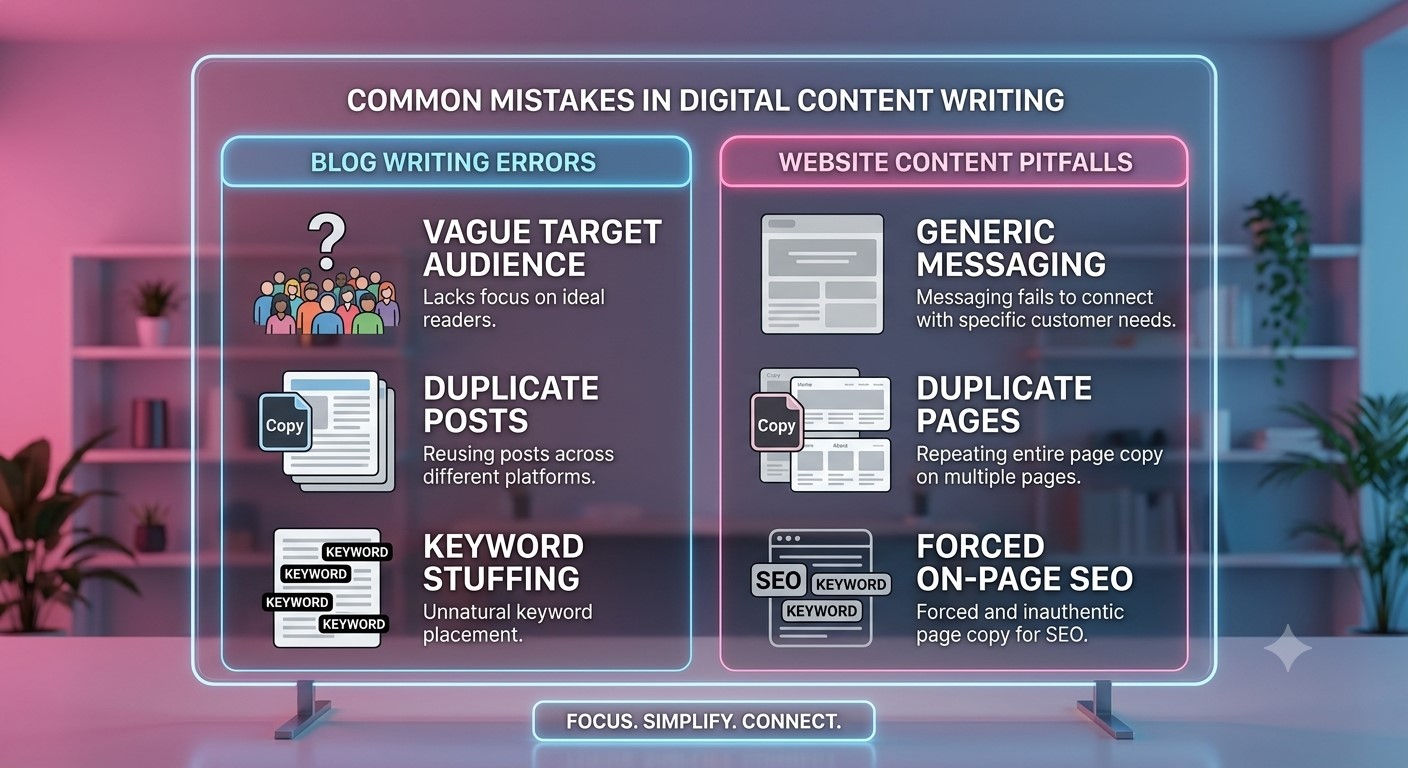
One common mistake is treating every page like a blog post. A service page that spends several paragraphs defining a general topic may fail to explain the actual service. Visitors should not have to search through an educational article to find out what you offer.
Another mistake is treating every blog post like an advertisement. Readers usually visit blog content because they want a clear answer. If the article quickly becomes a sales pitch, it may lose trust.
Other common mistakes include:
- Writing without a clear audience.
- Targeting keywords without understanding search intent.
- Using the same content across multiple pages.
- Adding keywords unnaturally.
- Publishing short articles that do not answer the question fully.
- Ignoring internal links.
- Forgetting to update outdated information.
- Using generic calls to action.
- Focusing on word count instead of usefulness.
- Creating content on topics unrelated to the business.
Google specifically warns against producing content mainly to attract search traffic, publishing large amounts of low-value content, and writing to meet an arbitrary word count. The quality of the answer matters more than reaching a particular number of words.
Best practices for better results
Start by identifying the purpose of each page. Ask whether the reader is looking for information, comparing options, evaluating a provider, or ready to take action.
Next, map content to the customer journey:
- Use blog posts for questions, education, definitions, and research.
- Use service pages for offers benefits, processes, and proof.
- Use landing pages for specific campaigns or audiences.
- Use case studies to demonstrate results and experience.
- Use comparison pages to help people evaluate choices.
Each page should have one main purpose. This does not mean it can rank for only one keyword. It means the page should provide a clear experience for the people who visit it.
Use headings to make the content easy to scan. Keep paragraphs short, explain specialist terms, and use examples where they make the subject clearer. Add original insights from your team rather than rewriting the same points found on competing pages.
Include relevant internal links, but do not add them simply to increase the number of links. A link should help the reader continue learning or take a logical next step.
Finally, measure performance based on the goal of the page. For blog content, review impressions, organic clicks, engaged visits, newsletter signups, and assisted conversions. For website pages, review enquiries, form completions, calls, bookings, sales, and conversion rate.
What businesses should choose
If your website has few or no useful blog articles, start by identifying the questions your audience asks before contacting a provider. These questions can become a practical SEO blog writing plan.
If your website receives visitors but generates few enquiries, review your core website pages. The problem may be unclear messaging, weak positioning, poor calls to action, or a lack of trust signals.
If your business has both problems, work on the two areas together. Publish useful blog content while improving the pages that convert visitors into leads or customers.
A small business does not need dozens of pages immediately. It needs the right pages, connected in a logical way. Ten well-planned articles and several strong service pages can be more useful than a large collection of thin, unrelated content.
Summary
SEO blog writing vs website content writing is not a competition between two opposing strategies. SEO blog writing helps people discover and understand your business. Website content writing helps them evaluate your offer and decide what to do next.
Blogs are usually best for informational searches, early research, and long-term organic visibility. Website pages are usually best for explaining your services, building confidence, and encouraging action.
The strongest content strategy combines both. Create blog posts that answer real questions, connect them to relevant service pages, and make sure every page provides a clear reason for the reader to continue.
At Digitory Marketing, we help businesses plan and create content that supports both visibility and growth. The aim is not to publish content for its own sake. The aim is to give the right reader the right information at the right stage of their decision.
Frequently asked questions
Is SEO blog writing the same as website content writing?
No. SEO blog writing usually focuses on educating readers and attracting organic search traffic. Website content writing focuses more on explaining a company, its services, and its value to potential customers.
Can website content rank on Google?
Yes. Service pages, product pages, location pages, and other website content can rank when they are relevant, useful, technically accessible, and aligned with search intent. Ranking is not limited to blog posts.
Should every business have a blog?
Not every business needs to publish frequently, but most businesses can benefit from answering the questions their customers ask. The right publishing schedule depends on your audience, resources, industry, and goals.
Which is more important for lead generation?
Website content often has a more direct role in generating leads because service pages and landing pages are built around a specific action. Blog content can support lead generation by attracting relevant visitors and directing them to those pages.
How long should an SEO blog post be?
There is no universal ideal length. An article should be long enough to answer the reader’s question properly, but it should not include unnecessary information just to reach a word count.
Can AI write SEO blog content?
AI can assist with research, outlines, drafts, and editing. However, content still needs human review, accurate information, original insight, a clear purpose, and a natural connection to the audience. AI should support quality, not replace it.
Key takeaways
- SEO blog writing attracts and educates people researching a problem.
- Website content writing explains your business and encourages action.
- Neither format is automatically better for every search or business.
- Blogs are often useful for informational and early-stage searches.
- Service pages and landing pages are often stronger for commercial intent.
- Internal links help readers and search engines move between related pages.
- Content should be created for people first, not just for search engines.
- Word count matters less than accuracy, usefulness, structure, and relevance.
- The best strategy connects blog articles with service pages and clear calls to action.
Contact us at https://www.digitorymarketing.com for your digital marketing services.