Introduction
Marketing might be one of the friendliest high-paying fields for people without a four-year degree in the subject. Employers increasingly care about what you can prove, not what your diploma says, and that shift has opened real doors. This article breaks down the highest-paying marketing jobs without a marketing degree, what actually gets you hired instead of a degree, and a realistic path to break in if you are starting from zero.
This is not a promise that any marketing job is easy to land. It still takes real skill, proof of results, and often a portfolio built on your own initiative before someone pays you for it. But unlike fields such as law or medicine, marketing has never required a specific credential to practice it. What has changed in recent years is that employers now say so openly, and they hire accordingly.
If you have been searching for the highest-paying marketing jobs without a marketing degree, the honest answer is that several exist, and the path in usually looks less like a classroom and more like a body of proven work. How Much Do Social Media Marketing Services Cost?
Can You Get a Marketing Job Without a Degree?
Yes, and demand for people who can do the work has grown, not shrunk. Marketing rewards measurable outcomes: traffic, leads, conversions, engagement and revenue. Because those results are trackable, employers can verify skill directly through a portfolio or a case study instead of relying on a credential as a stand-in for ability.
That is different from fields where a license or accreditation is legally required. Nobody needs a certificate to write a high-converting headline or run a profitable ad campaign. What employers actually check before hiring tends to include:
- A portfolio of real campaigns, content, or results, even from personal or volunteer projects
- Familiarity with the tools the role actually uses day to day
- Relevant certifications that show you understand the fundamentals
- Communication skills, since most marketing roles involve constant client or stakeholder interaction
What Are the Highest-Paying Marketing Jobs Without a Marketing Degree?
Several marketing roles consistently pay well and rarely require a specific degree, as long as you can show the skills and results. Here is a realistic breakdown of where the money tends to be among the highest-paying marketing jobs without a marketing degree:
Digital Marketing Manager. Oversees a company's overall online marketing strategy, from paid ads to email to content. Experienced digital marketing managers commonly earn in the mid five figures at agencies or in-house, with freelancers who have a strong client portfolio often earning more.
- SEO Specialist or SEO Manager. Focuses on improving organic search visibility through keyword research, technical fixes, content strategy, and link building. This role is almost entirely skills-based, and a strong track record of ranking results often matters more to employers than any credential.
- Social Media Manager or Strategist. Runs a brand's presence across platforms, plans content calendars, and increasingly manages paid social campaigns as well. Pay varies widely by experience and whether the role includes ad management, but skilled social strategists with measurable growth results can earn well above entry-level marketing pay.
- Content Marketing Manager. Leads a company's blog, video, or long-form content strategy. A degree is sometimes preferred here, especially in writing-heavy industries, but is very rarely a hard requirement if your writing samples and SEO results speak for themselves.
- Marketing Analytics Manager. Turns campaign and customer data into decisions. This is one of the higher-paying marketing roles overall, and while some employers prefer a quantitative background, strong tool fluency and a demonstrated ability to read and act on data can outweigh a formal degree.
- Paid Media or PPC Manager. Manages ad spend across Google Ads, Meta Ads, and other platforms. Because ad performance is directly measurable, this is one of the clearest examples of a marketing role where results speak louder than credentials.
- Email Marketing Specialist. Builds and manages email campaigns, automation flows, and list segmentation. It is often underestimated as an entry point, but experienced email marketers who can prove strong open and conversion rates are in steady demand. careers-in-digital-marketing
Several of these role's scale into six-figure territory with enough experience, especially through freelancing, agency ownership, or moving into a director-level position later on. Executive-level roles like Chief Marketing Officer do tend to favor candidates with an MBA or advanced degree, so if the long-term goal is the C-suite, which is one area where formal education still carries real weight.
It is worth being honest about the range here too. Entry-level pay in any of these roles without prior experience will look modest at first, closer to what any entry-level job pays. The real earning potential in the highest-paying marketing jobs without a marketing degree tends to show up two to five years in, once a track record of results exists to negotiate with.

What Certifications Matter More Than a Degree in Marketing?
Certifications function as a fast, credible way to prove foundational knowledge, and employers hiring for these roles specifically look for a handful of them:
- Google Ads and Google Analytics certifications, which show you can run and measure paid campaigns
- HubSpot Academy certifications, covering inbound marketing, content, and email
- Meta Blueprint, for social and paid social competency
- SEMrush Academy courses, for SEO and competitive research skills
None of these replace real experience, but they signal that you understand the fundamentals well enough to be trusted with a live campaign or client account. For someone starting from zero, a sensible sequence is to pick one platform-specific certification, apply it to a real or practice project, then add the next certification once you have something to show for the first one.
What Skills Matter More Than a Degree in Marketing?
Beyond certifications, a specific set of skills tends to separate people who get hired from people who do not:
• Copywriting, since nearly every marketing role touches messaging in some form
• SEO fundamentals, even outside a dedicated SEO role
• Paid advertising literacy, at least at a working level
• Data and analytics comfort, enough to read a dashboard and explain what it means
• Tool fluency in platforms like SEMrush, HubSpot, Meta Ads Manager, and Google Ads
A portfolio of real work, even unpaid or self-initiated, consistently outweighs a degree in hiring conversations. Employers want to see that you can actually do the job, and a well-documented case study does that more convincingly than a transcript.
How Do You Start a Marketing Career with No Experience?
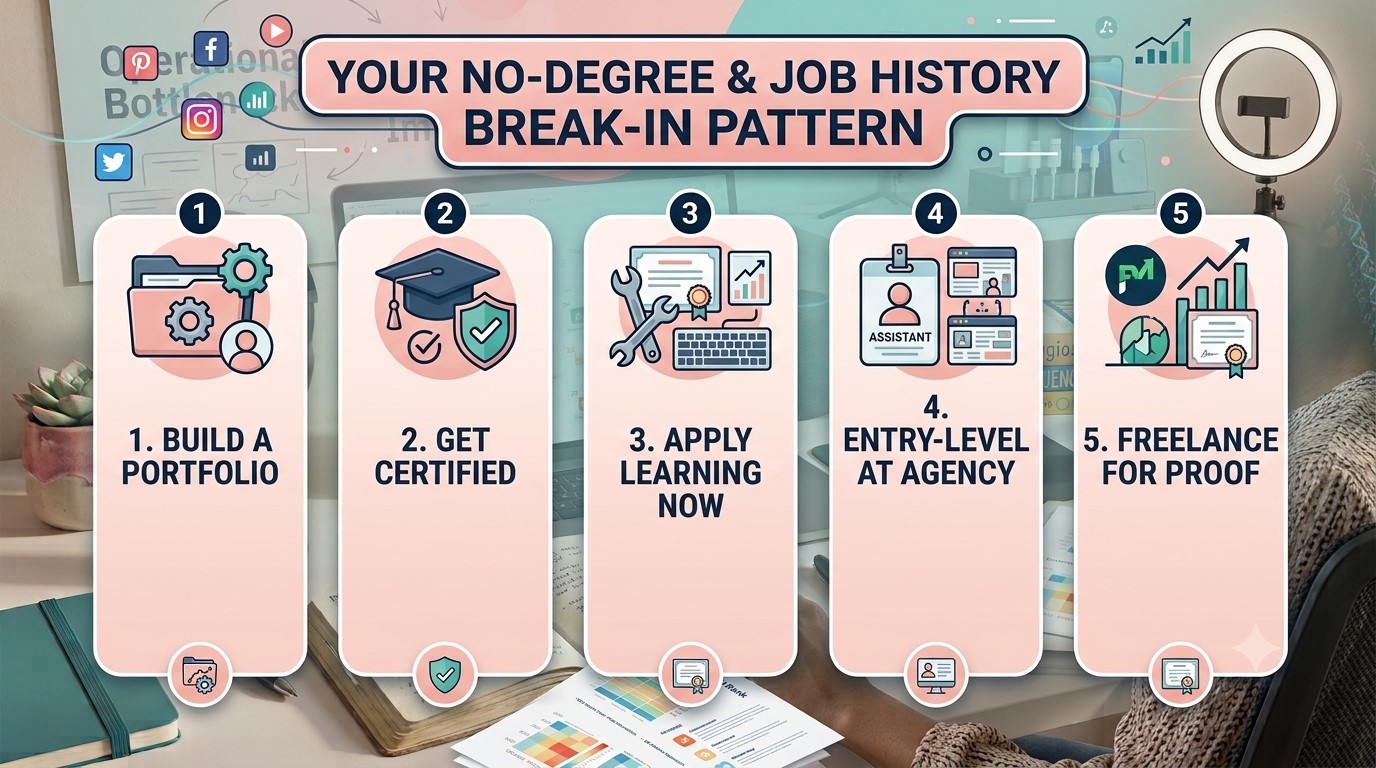
Breaking in without a degree or a job history usually follows a similar pattern:
- Build a small portfolio first, even if it means running a campaign for a friend's business, a nonprofit, or your own project
- Pick one or two certifications that match the role you want and complete them
- Apply what you learn immediately, since a certification alone rarely gets noticed without proof it was put into practice
- Consider an entry-level or assistant role at an agency, which exposes you to multiple clients and skills faster than working solo
- Use freelance platforms as proof of work, not just income but early on
This is a slower path than a traditional degree track, but it tends to move faster in practice, since each step produces something concrete an employer can evaluate.
Is a Marketing Degree Necessary at All?
For most operating marketing roles, no. A degree is not a hard requirement, and plenty of successful marketers built their careers through certifications, freelance work, and self-directed learning instead. Where a degree still carries more weight is at the executive level, in large enterprise organizations, or in regulated industries where formal education is part of a broader compliance expectation.
If the goal is a hands-on marketing career, whether in SEO, social, paid media, or content, skills and proof of results are the more direct path in. If the long-term goal is an executive marketing role like CMO, a degree, and often an MBA, tends to remain a meaningful advantage.
Where This Is Heading
Skills-based hiring in marketing is not a temporary trend. As more companies adopt AI tools for execution, the value of a marketer shifts further toward strategy, judgment, and the ability to interpret results, none of which a degree guarantees on its own. Expect the gap between credential-based hiring and proof-based hiring to keep widening in marketing specifically, even as it moves more slowly in fields with formal licensing requirements. For someone building a career now, that trend works in your favor if you focus on producing real, documented results early.
Summary
The highest-paying marketing jobs without a marketing degree exist across digital marketing management, SEO, social media, content, analytics, and paid media, and all of them reward proof over credentials. Certifications from Google, HubSpot, Meta, and SEMrush give you a credible starting point, but a real portfolio of results is what actually gets you hired and promoted from there.
Marketing remains one of the more accessible high-paying fields for people without a formal degree, precisely because the work itself is measurable. If you can show the results, most employers will care far less about how you learned to produce them.
FAQ Section
- Can you get a marketing job without a degree?
Yes. Most marketing roles are skills-based rather than credential-based, and employers commonly hire based on certifications, portfolio work, and demonstrated results instead of a formal degree.
- What is the highest-paying marketing job without a degree?
Roles like digital marketing manager, marketing analytics manager, and paid media manager tend to pay well and rarely require a specific degree, especially with several years of proven experience.
- What certifications help you get a marketing job without a degree?
Google Ads, Google Analytics, HubSpot Academy, Meta Blueprint, and SEMrush Academy certifications are commonly recognized by employers as credible proof of foundational marketing knowledge.
- How long does it take to start a marketing career without a degree?
It varies, but many people build a basic portfolio and complete one or two certifications within a few months, then use that work to apply for entry-level or freelance marketing roles.
- Do you need a portfolio for a marketing job?
Almost always, yes. A portfolio, even built from personal or volunteer projects, is usually the most convincing proof of skill an employer can evaluate without a degree in the mix.
- Is digital marketing a good career without a degree?
Yes. Digital marketing is one of the more accessible high-paying fields for people without a Degree, since results like traffic, leads, and conversions are directly measurable and provable.
Key Takeaways
- Marketing is one of the more accessible high-paying fields for people without a formal degree, since results are directly measurable.
- Roles like digital marketing manager, SEO specialist, marketing analytics manager, and paid media manager consistently pay well without requiring a specific degree.
- Certifications from Google, HubSpot, Meta, and SEMrush are credible substitutes for formal education in most hiring conversations.
- A real portfolio, even from personal or volunteer projects, tends to outweigh a degree when employers are deciding who to hire.
- Executive-level roles like CMO still tend to favor candidates with a degree or MBA, so that is one area where formal education keeps more weight.
- The fastest path in usually combines one or two certifications with real, applied project work, not certifications alone.
Contact us today at https://digitorymarketing.com/contact us for your Digital Marketing services.